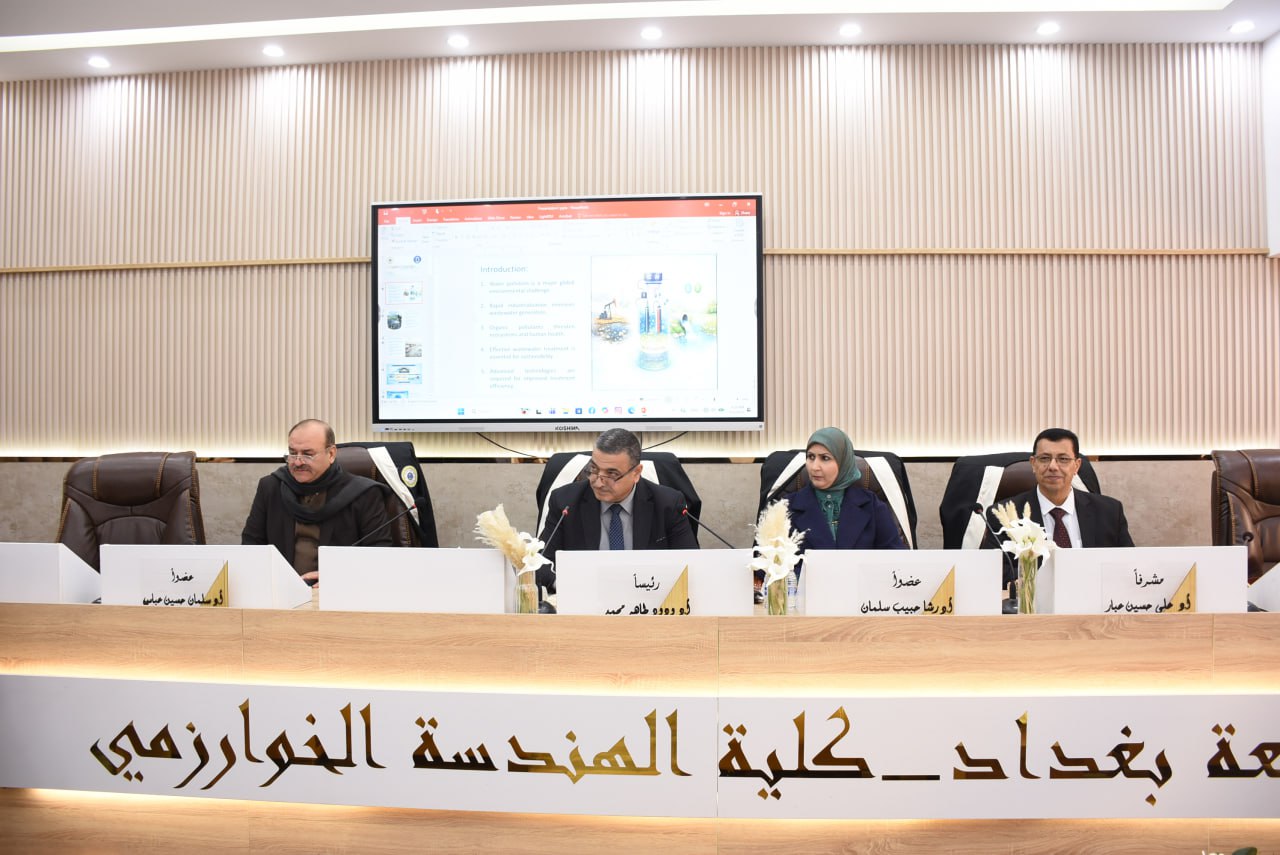

On Thursday, February 2nd, 2026 at the college thesis hall, Al-Khwarizmi College of Engineering held a master thesis using photocatalysis method with a novel Sn-O2 photo anode for the master candidate (Heba Fareed Younis) and a degree of pass with distinction was awarded to her for her findings:
The study aims to treat heavily polluted water including tetracycline solutions and petroleum refinery wastewater through using photo-anodic oxidation and photo-electrochemical (PEC) processes based on a novel SnO₂ photo-anode.
Photo-anodic oxidation achieved a tetracycline removal efficiency of 84% at a current density of 5 mA/cm² and pH 5, aided by enhanced mass transfer and NaCl addition. The PEC process employing a Gr/Ni-Sb-SnO₂ photo-anode resulted in 83.7% tetracycline removal with relatively low energy consumption, while exhibiting a clear synergistic effect compared to photocatalysis alone. Furthermore, the developed Gr/Bi-Ni-Sb-SnO₂ photo-anode demonstrated high photocatalytic activity and excellent stability over multiple operational cycles. In treating petroleum refinery wastewater, a COD removal efficiency of 86.2% was achieved, following pseudo-first-order kinetics.
The outcomes of this work were published in internationally indexed journals ranked within Q1 and Q3, as well as in peer-reviewed local journals, and were submitted for Iraqi patents, highlighting the scientific significance and practical applicability of the proposed photo-anode system.
Based on these findings, future work is recommended to expand the application of the system to other persistent pollutants, evaluate its performance under natural solar irradiation, assess long-term electrode stability, and investigate scale-up and integration with advanced oxidation or biological treatment processes.