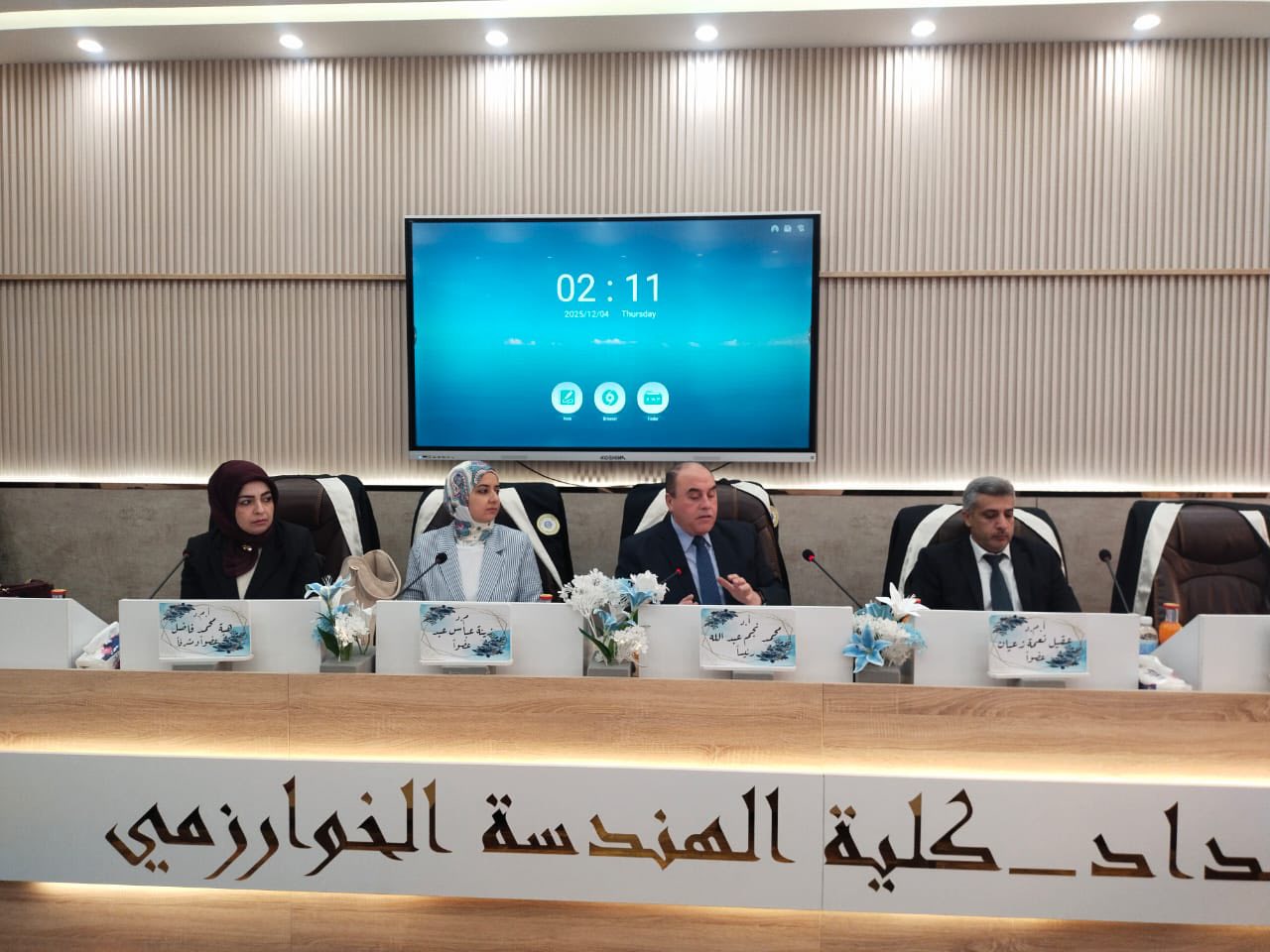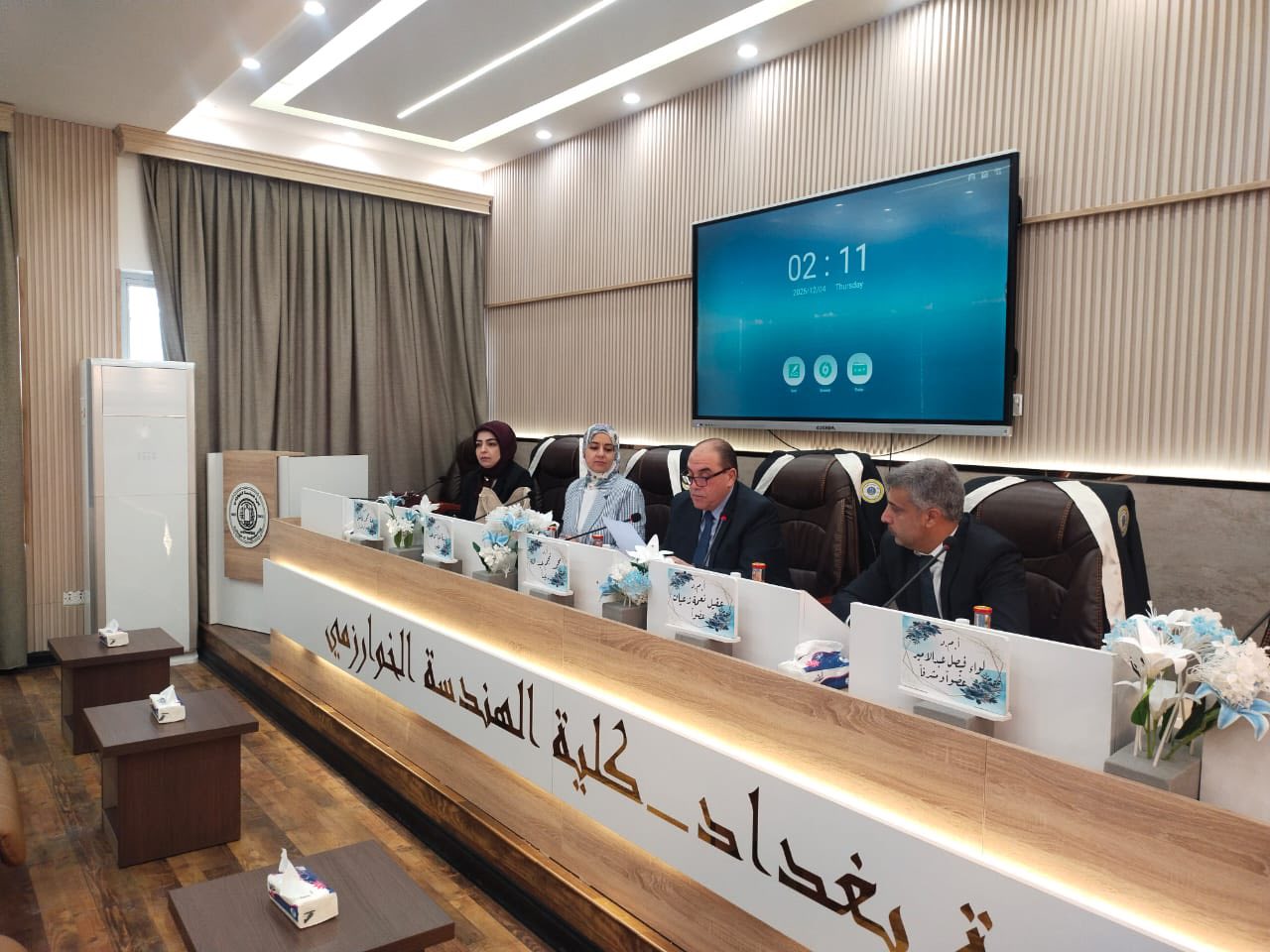

On Thursday, December 4th, 2025, Al-Khwarizmi College held a master’s defense of the master candidate, Aya Adil Hamid, from the Communication and Information Engineering Department, titled (6G NOMA Enabled visible light communications based on machine learning algorithms), at Higher Studies Hall. A degree of pass with distinction was awarded to her. The thesis demonstrated that the communications model combined the usage of three significant techniques of 6 G communications:
“Visible Light Communication” (VLC) and “Non-Orthogonal Multiple Access” (NOMA), enhanced by Federated Learning (FL) for intelligent and privacy-preserving optimization. VLC utilizes unlicensed optical spectrum for high-speed, interference-free data transmission, while NOMA enables multiple users to share the same frequency band via power-domain multiplexing. However, practical challenges such as signal interference, resource allocation, and nonlinear channel effects limit VLC-NOMA performance.
To address these issues, the system model was developed to incorporate machine learning, specifically federated learning, which enables distributed training without exposing raw user data. The system employs deep learning algorithms for real-time path prediction, dynamic power allocation, and channel estimation. Extensive simulations evaluated communication quality metrics, including latency (< 2.7ms), bit error rate (BER < 0.01), and “signal-to-interference-plus-noise ratio” (SINR up to 10 dB) across 200 clients in a simulated indoor environment. Results demonstrate that the proposed ML-enhanced VLC-NOMA system achieves significant improvements in spectral efficiency, scalability, and link reliability. Furthermore, federated learning ensures model convergence with over 90 % global accuracy, preserves user privacy, and enables generalization across diverse user clusters. These findings position the system as a viable solution for smart indoor environments and IoT-centric 6G networks.